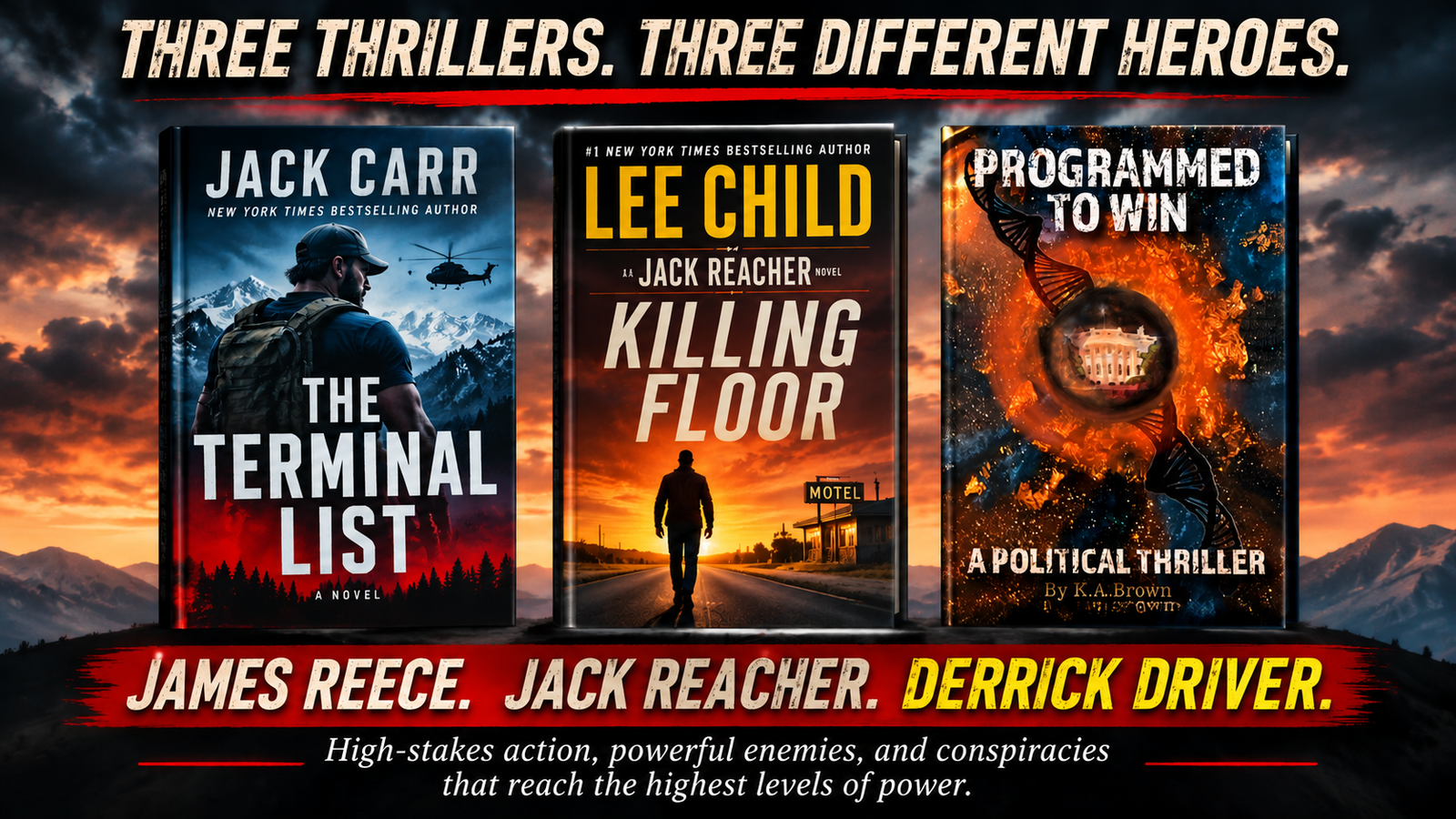
What makes a thriller hero memorable? The ability to win a fight matters, but the decision to get involved often matters more. A character becomes compelling when the danger has a cost and the reader understands why he accepts it.
That is one reason I enjoy looking at the differences between Lee Child’s Jack Reacher, Jack Carr’s James Reece, and Derrick Driver, the central character of my own thriller series. These men are not interchangeable. Their backgrounds, instincts, and relationships lead them into different kinds of stories. But they do offer readers some overlapping pleasures: a strong sense of purpose, powerful opponents, and consequences that cannot always be avoided.
Jack Reacher: The outsider who notices what others miss
Reacher, introduced in Killing Floor, is a former military policeman who travels light and rarely stays in one place. He is especially effective as an outsider: he enters a situation, recognizes that something is wrong, and refuses to accept the easy explanation. The suspense often grows from watching his investigative instincts collide with people who believe they control a town, a system, or the truth.
Reacher’s independence is central to his appeal. He is not usually balancing the obligations of a permanent home or a close-knit recurring team. That freedom gives his stories a distinctive rhythm.
James Reece: Loyalty, loss, and the price of betrayal
Jack Carr’s James Reece begins The Terminal List as a Navy SEAL facing devastating loss and betrayal. His military background shapes the methods he uses, but the emotional engine is intensely personal. Reece’s story asks what a person will do when trusted institutions fail him and the people he loves pay the price.
Readers who appreciate the combination of personal stakes and far-reaching conspiracy may recognize a thematic connection with The Cost of Killing. The characters are not copies of one another. Their experiences and the moral questions surrounding their decisions are different.
Derrick Driver: The reluctant protector who stays connected
Derrick comes from a different professional world. He served in Boston police SWAT and later as a detective, before moving into private security. His investigations draw on experience with people, evidence, and the realities of violence. But Derrick’s defining trait is not simply what he can do. It is his difficulty walking away when he knows someone needs help.
In Programmed to Win, the story grows into a political conspiracy thriller with a genetic-manipulation dimension. In The Cost of Killing, loss and the desire for revenge test Derrick in more personal ways. Across the books, the people around him matter. Friends and allies are not just supporting equipment for the next confrontation. Their relationships change the stakes.
Where Reacher often operates as a self-contained outsider and Reece brings a special-operations perspective, Derrick has roots, history, and people who will challenge his decisions. That creates a different kind of pressure, especially when the danger follows him home.
What these three heroes share
All three can recognize danger and act decisively. More importantly, all three are willing to confront opponents with greater resources, institutional protection, or political influence. Their stories explore loyalty, responsibility, and what happens when official power is used for the wrong reasons.
Those similarities are a starting point for readers, not a promise that the books deliver identical experiences. A Reacher novel, a James Reece thriller, and a Derrick Driver story have their own voices, pacing, and moral complications. That variety is part of the appeal of reading across the genre.
Where to begin
If you enjoy a lone investigator, start with Lee Child’s Killing Floor. If you want a military-rooted story of betrayal and revenge, consider Jack Carr’s The Terminal List. If you’re curious about a former detective pulled into political intrigue and emerging science, begin Derrick’s story with Programmed to Win.
For more options, visit the Reader Recommendations page, where I also discuss novels by Mark Greaney, Gregg Hurwitz, and Daniel Suarez.
Read the prologue and first two chapters of Programmed to Win free →
This is an independent editorial comparison. No endorsement or affiliation with Lee Child, Jack Carr, their publishers, or the other authors mentioned is implied.